

Route 50 between Red House, Maryland, and the Cheat Mountain in West Virginia is one of my favorite stretches of concrete. Known as the George Washington Highway in these parts, this segment is relatively straight and flat. You can “make good time” here after being irritated and delayed by overloaded trucks slowing to a crawl on Cheat Mountain or the Allegheny Front. The absence of traffic lights ensures clear sailing.
Both towns on this stretch, Aurora and Red House, were settings for my family’s story. At the Red House intersection of routes 219 and 50 is the Lutheran Church where my parents, Carl J. and Cossette Watring Feather, were married in 1952. Next door to the church is the abandoned gas station that my father planned to purchase and operate after high school. A draft notice changed that trajectory.
My father grew up near Route 24 in Eglon, went to high school in Aurora and walked there across the mountain. He speaks of taking his firearm to school so he could hunt squirrels along his route.
My late great aunt lived in Aurora, as did her brother, Willard Feather, who had farm machinery business that helped many of the farmers in this region transition from horse-powered to mechanized agriculture in post-World War II years.
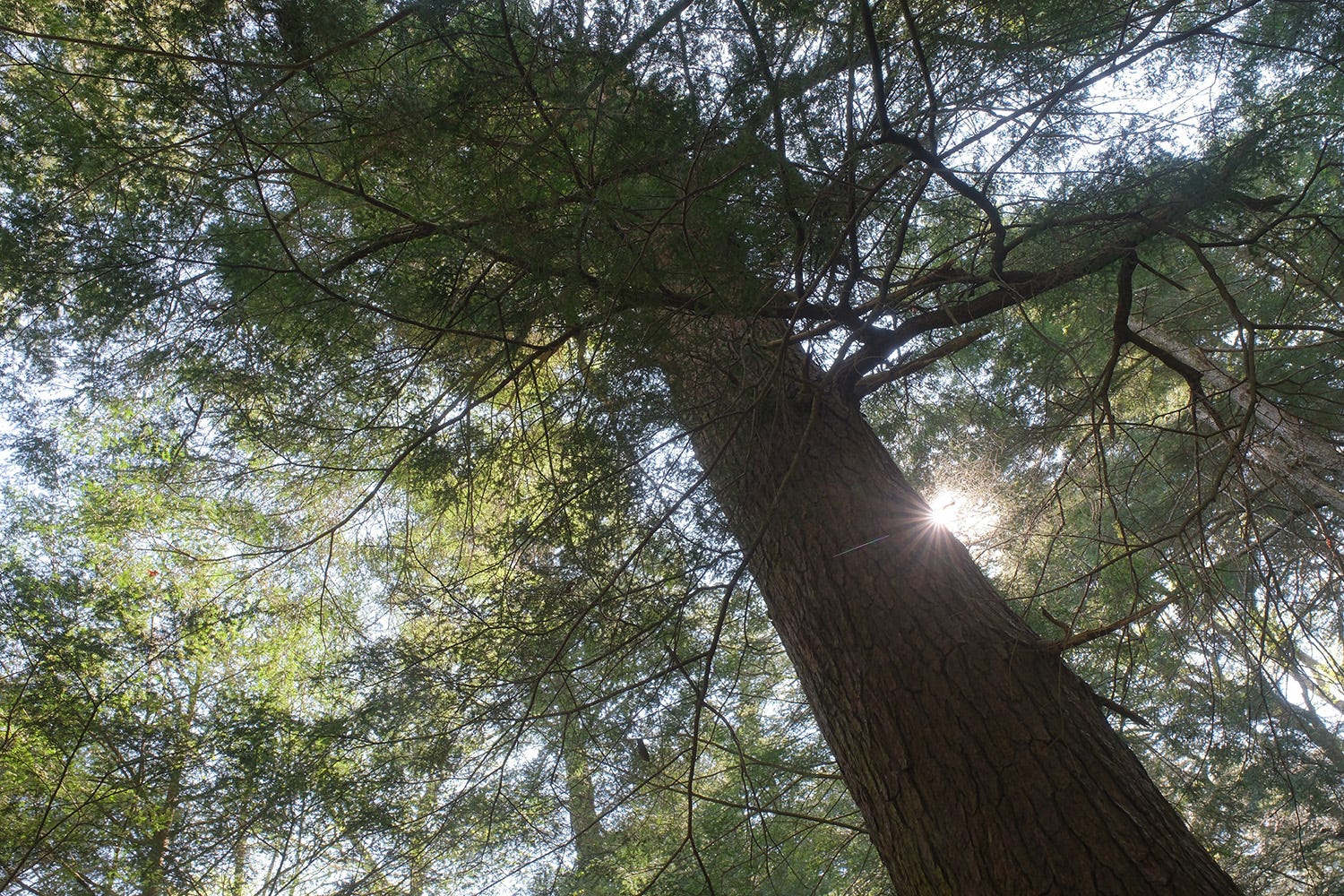
The Deerwood Gas and Outlet Store, owned by a distant cousin and her husband, is the de facto community center by virtue of the hours it keeps and that most every resident needs gas to get to work or shop. Cathedral State Park, a virgin hemlock forest, is the most popular tourist destination here. A stone tavern dating to the early 1800s stands to the east of the park but is a private residence.
Other places of note are an elementary school, Lutheran Church, cemetery, Dollar General, Melanie’s Restaurant, historical society museum, fire department, stone community center and the Aurora Project art gallery and event space, housed in a general store. The Project also owns several buildings that were once part of the infrastructure that served guests who came to Aurora from Washington, D.C. and environs to escape the summer heat and humidity.
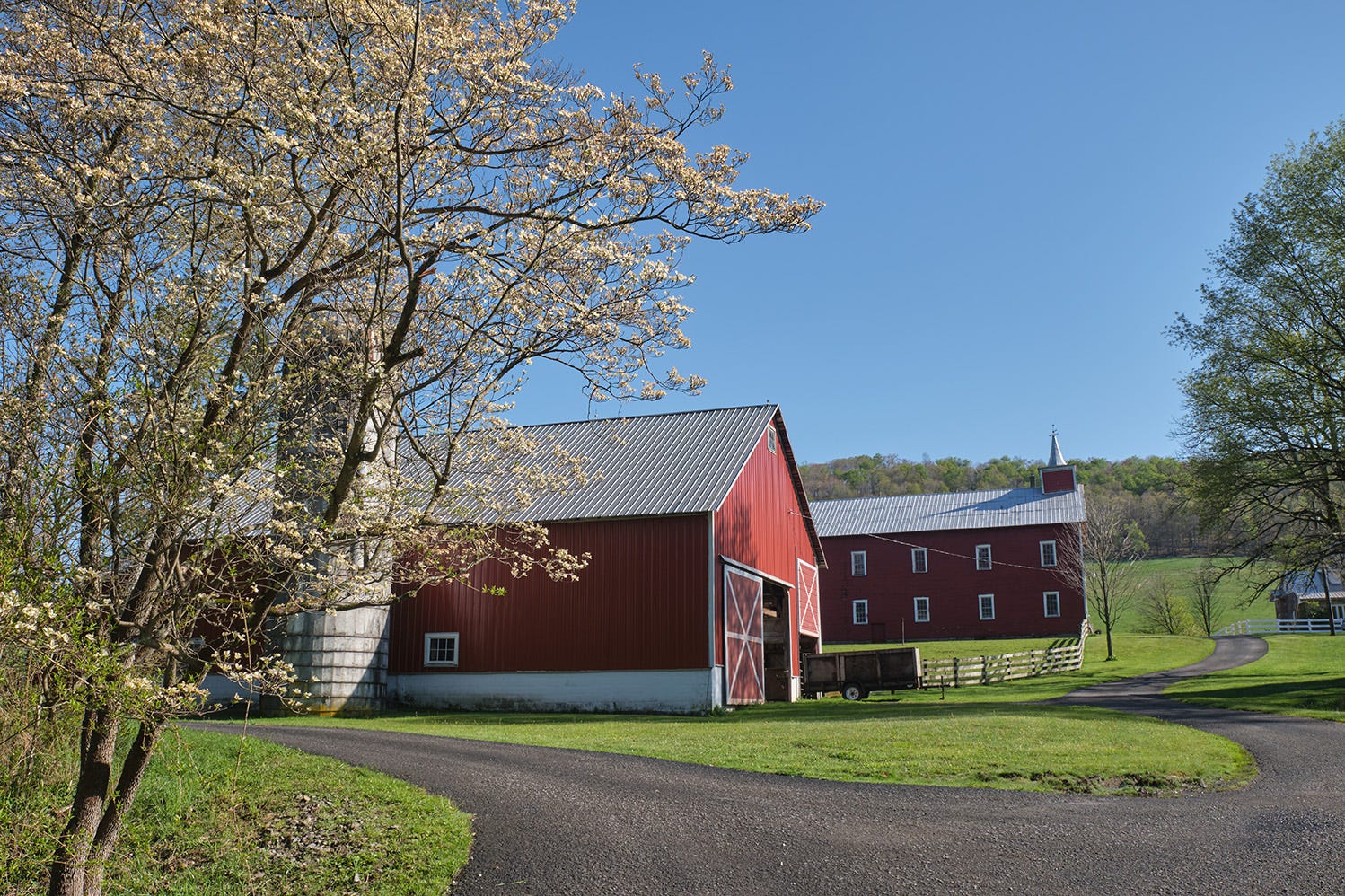
The Brookside Farm was part of that industry and once supplied the meat, eggs and vegetables for the folks who stayed in the cottages and inn on the other side of the highway. The entities still collaborate as Jacob’s Ladder, an innovative 6-month residency drug-rehab program.
Brookside has what may be the most beautiful red barn in all of West Virginia. It is one of the 11 buildings that make up the Brookside Historic District on the National Register of Historic Places. According to the application prepared by Courtney Fint Zimmerman of Aurora Research Associates, these structures date from the late 1800s to 1950.
The livery barn is a two-story, heavy-timber framed building with gabled roof and stone foundation. A large cupola with hipped roof and steep spire at the east end and primary entrance draw attention to the handsome, red structure. The barn has a central passageway running the entire 120 feet of its length. Animal pens are on either side of the passageway; the ground level ceiling is finished in tongue-and-groove maple, while wormy chestnut board-and-batten lumber embellish the walls.
The Utterback family owns and operates the farm with help from Jacob’s Ladder residents. A couple of decades ago, when the Aurora Project needed a way to introduce itself and mission to the community, it worked with the Utterbacks to hold a barn dance there. The event, held in early October, became a much anticipated and appreciated event. Then COVID-19 came along, and, after 16 annual dances, the music and dancing stopped.
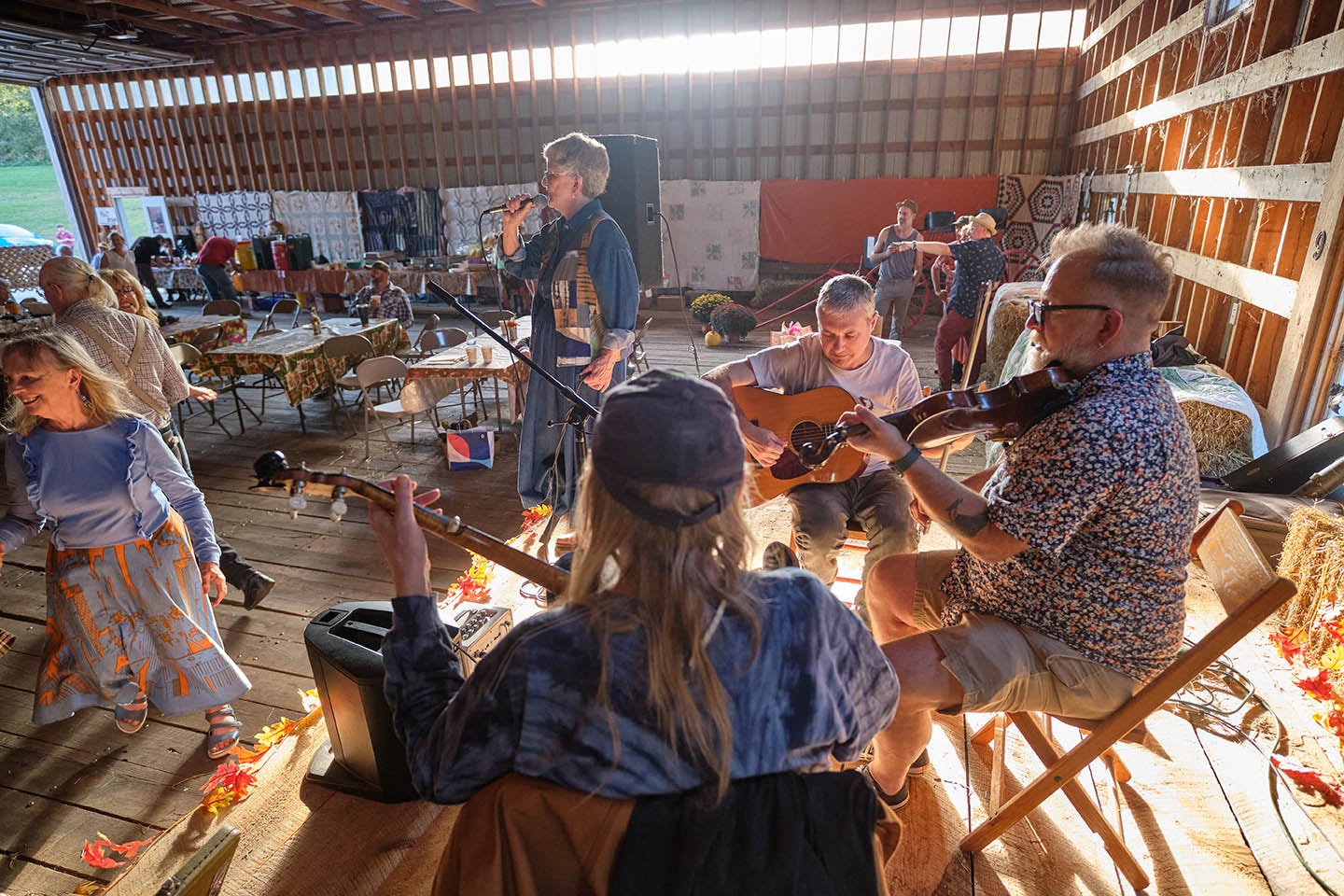
Aurora Project revived the tradition last year; Barn Dance 2.0 attracted nearly 200 participants. Due to the work involved in transforming a working livestock barn into a venue with food and dancing, the Utterback barn could no longer be used. A close neighbor of the project, Joe Fint, offered his massive barn to the project.
This year’s dance is 2 to 6 p.m. October 5. It’s a family venue for square and other traditional dances with a caller and live music, including the incredible Aurora Celtic and Born Old, the latter group’s name expressing my lifelong sense of being.
I recently met with Joe Fint in the barn where the dance will be held. Joe grew up on this farm, which his father purchased from the Jacob B. Beachy family in 1941. Jacob D. was the son of Daniel J. and Elizabeth Yoder Beachy, Amish settlers who came to Aurora in 1853.
Fifteen years later, they built the first section of their barn using post and beam construction.
“It’s built the Amish way,” Joe said. “The original barn was 50 by 100 feet. Later on, in the 1920s, they built a 30-by-100-feet shed. And then I recently added a 68-by-96 (feet) addition. I don't know what square footage is, but it's pretty good size barn.”
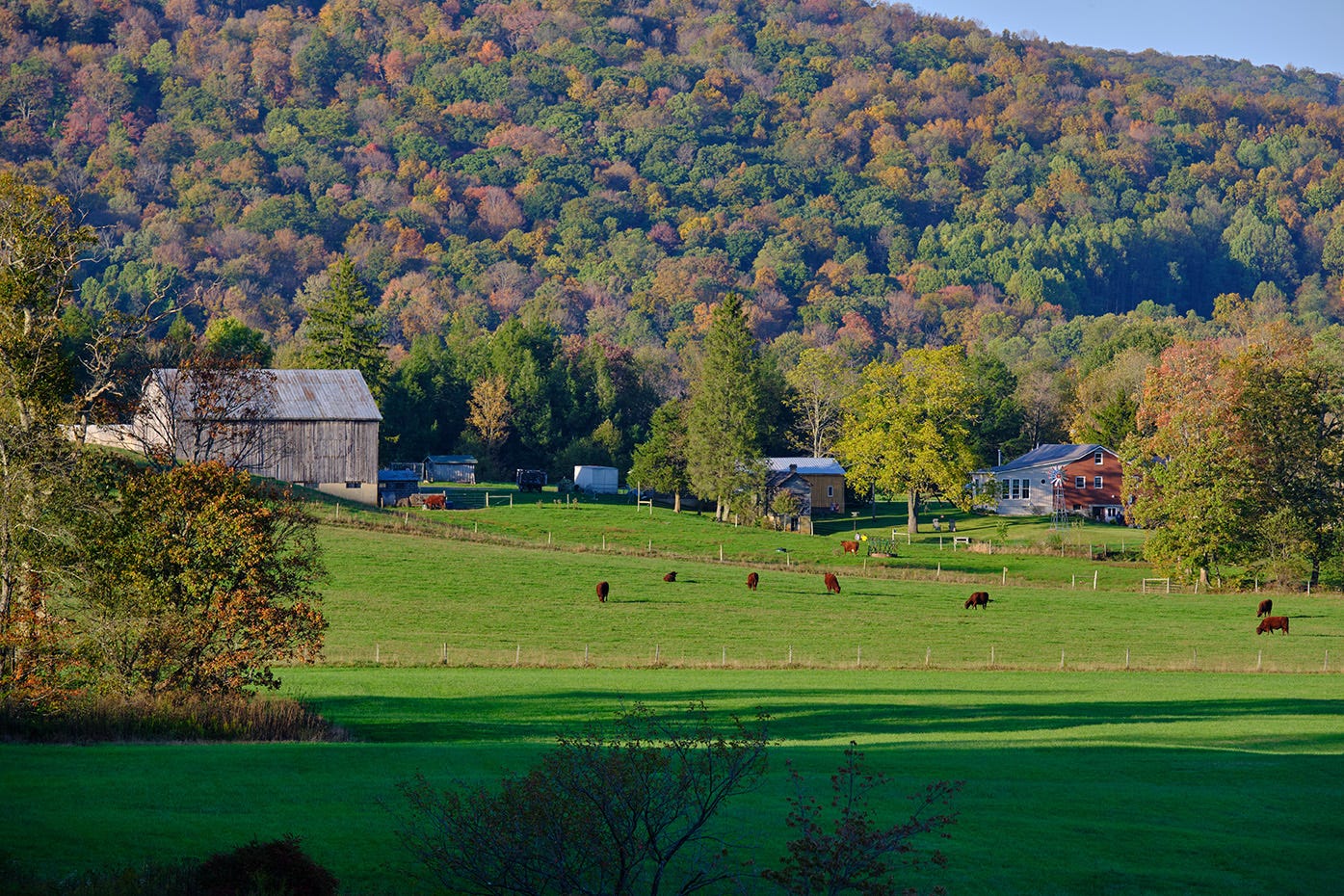
Joe farms 800 acres on which he grows hay for the horse market in Florida.
“They like our hay (from) here because it is a cold-climate hay,” Joe said. “We grow orchard and timothy (grass). The horse people like that hay. It's almost like a Canadian hay because we are almost 3,000 feet in altitude here, and it makes a good cold-weather hay growing season.”
The barn has been repaired, reinforced and modified to meet the needs of a large-scale hay farm, which is dependent upon heavy machinery to harvest and move the bales. A lower level provides storage for some of that equipment. Joe says the equipment alone is worth more than a half-million dollars.
There’s no fencing on the farm, so bringing livestock onto the land would require a huge investment. And Joe has no interest in going back to the days when the farm had dairy and beef cattle.
“We had a dairy when I was a kid, and I swore that if I ever got this farm, I would never milk another cow because I didn't like it,” he said. “The beef cattle weren't too bad, but we have no fences anymore, and beef cattle take a lot of work. And somebody's gotta be here all the time.”
Joe spends the winters in Florida, where he runs the sales side of the hay business. The barn in Aurora has storage for 35,000 bales.
The original house that Joe grew up in was lost to fire in 1985. He is one of four children who were reared on the farm. Now it’s just Joe in a new house near the barn.
“I was born here, my whole family grew up here, and that's where we got our work ethic. We all had our chores, we all had our things to do,” Joe Said. “We never had these phones that they use today to text and all this stuff. We always got up at six o'clock in the morning, did our chores, came back from school, did more chores, and we were promptly in bed, nine, ten o'clock every night. It was a good work ethic. And we all liked to work, we still love to work.”
That’s good, because it requires a lot of work to clear out hay and machinery, and clean the barn, and set up and tear down tables, chairs, stage and lighting for the event. Thanks to Joe’s work and generosity,
tradition and the arts have a presence in a community that has inspired creators for generations.
The very modest $15 entrance fee for adults includes a buffet meal of Italian sausage, chili, corn bread and a vegan option. A spread of desserts provides the perfect match for the fresh-pressed cider.
Novice dancers and experienced alike are welcome.
“I think that you have to have the right attitude,” Joe said. “You have to be willing to participate. They have the square dance, and even if you don't know how to square dance, they teach you to do that. And there’s the food, and for a lot of the people, it’ll be just a good conversation area.”


