
The courage to share
Tucker County author writes about her 1,000-mile journey with a--- cancer

Cancer. It’s a word nobody wants to hear from their doctor, especially within days of saying “I will” to a marriage proposal. But that is what happened to Parsons resident Laura Zick-Mauzy 12 years ago.
Zick-Mauzy, in her mid-60s, is the author of Cancer: A Journey of a Thousand Miles, a work of “creative fiction” that blends her life and faith journey with the diagnosis of anal cancer.
“Anal”; yes, you read that right. And she was still willing to share her story, and very frankly, at that.
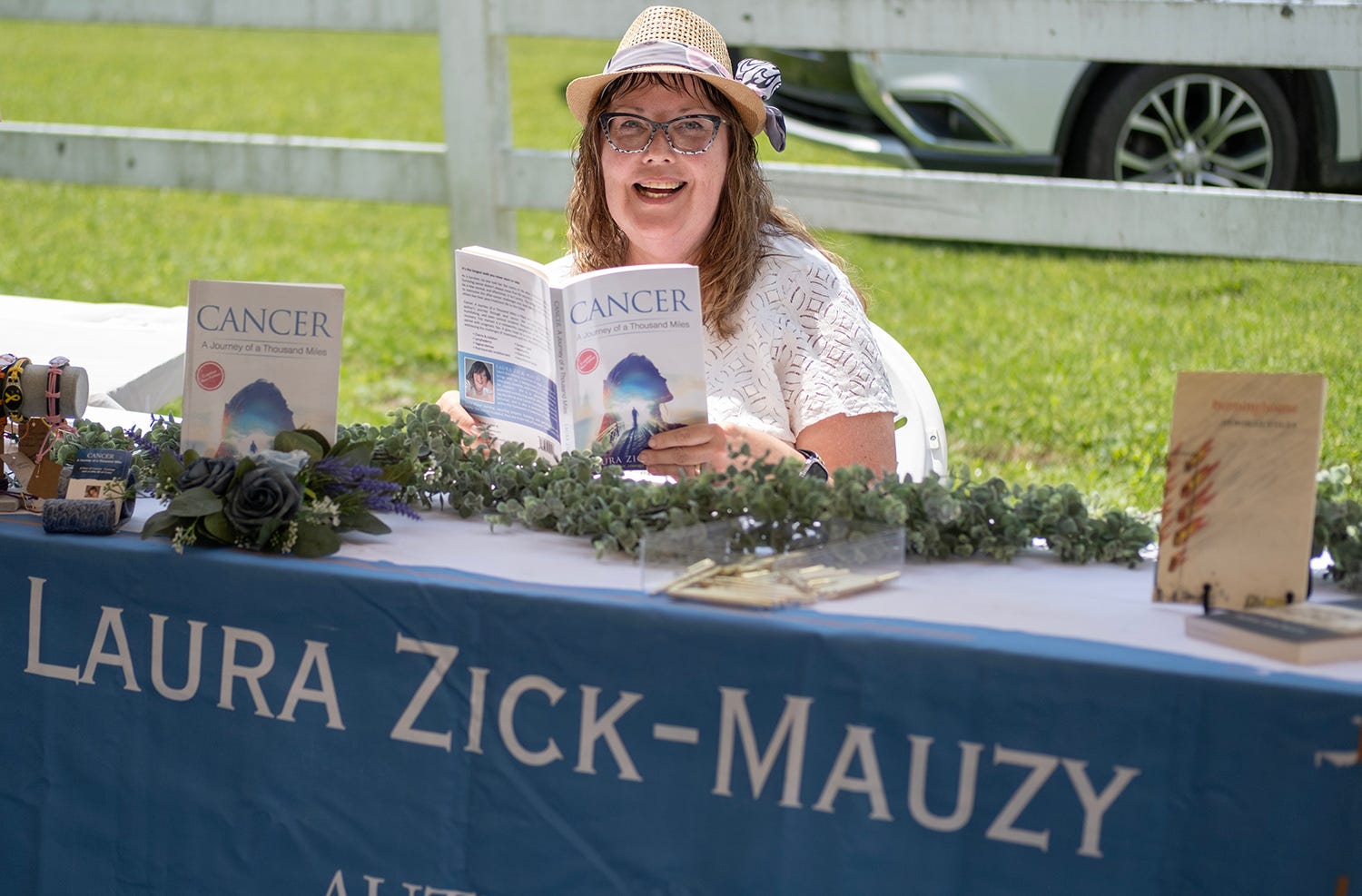
Laura Zick-Mauzy is a Parsons resident and anal cancer survivor. She wrote a book about the difficult topic and her journey through diagnosis, treatment and the 12 years since it was discovered. She had no symptoms; it was detected during a colonoscopy, which she encourages everyone to have. The cancer is rare, and women have a higher incidence than men. It is almost always caused by the Human Papillomavirus.
“Some people won’t even say the word “anal,” Laura writes. “Others, upon learning the diagnosis, make the presumption that the patient MUST have had anal sex all the time. So, they’re a freak in that regard, too. Some patients tell their family/friends that they’ve been diagnosed with stomach, colon, or even rectal cancer. Anything other than ANAL cancer.
“I don’t understand the stigma. If there’s a body part, cancer cells can congregate there,” she wrote. “Say it with me now. Out loud. ‘Anus.’”
Almost all cases of anal cancer are caused by Human Papillomavirus (HPV), according to the Moffitt Cancer Center’s webpage, “A Closer Look at the Cancer that Claimed Farrah Fawcett.” The actress died June 25, 2009, from liver cancer. She was diagnosed with anal cancer in 2006 and underwent chemotherapy and radiation treatments that brought about a short-lived “cancer-free” status in 2007 before it was discovered that the malignancy had spread to her liver.
“. . . people need to understand what it does to the body,
how to get through that, and how to manage the side effects,
because a lot of the doctors don’t talk about that.”
From blog to book
After receiving her diagnosis, Laura researched Fawcett’s journey and those of others who had the courage to go public with their stories. Despite hoping for triumphant endings, she found none.
“I decided they just hadn’t been written yet,” she writes in her book, which took a decade of thought and coming to grips with the emotions, lingering side effects, and ongoing screenings inherent to anal cancer.
“I started a blog of sorts through WordPress, and I just began putting my experiences out there,” she said. “So, I was like, people need to understand what it does to the body, how to get through that, and how to manage the side effects, because a lot of the doctors don’t talk about that.”
She began writing the book in 2015, but the thought of having to put her story and herself before an audience of readers held her in a grip of fear and anxiety. “I used to take Valium to get through speech class in college because I didn’t want to be up there,” she said. “And that wasn’t (talking) about something personal that you were dealing with.”
When the book finally came together in 2024, Laura released a raw, triumphant story laced with both humor and faith. It’s four books in one:
· a narrative of her prior marriages and the romance that brought her and Paul Mauzy together at the altar on April 6, 2013 (she received chemotherapy that morning);
· a patient’s guide to the disease and the treatment regimen of chemotherapy and radiation, and suggestions for friends and caregivers;
· a witness to her faith in God;
· a manifesto for taking up the fight against of mankind’s ugliest enemies—and winning.
Laura is very frank when describing the horrible effects that chemotherapy, radiation and diagnostic testing inflict. While she did not experience the nausea and vomiting often associated with the treatments, she did have hair loss, plummeting white blood cell counts, incontinence/humiliation and stroke-like symptoms.
Diagnostic procedures compounded the suffering induced by the radiation and chemotherapy. The frequent colonoscopies, which required two days of preparation, were especially torturous.
“I was in so much pain,” she said. “I was hospitalized for eight days, and I was just worn out. And then I had to do the two-day prep. And it was brutal, especially when your pelvic organs are pretty much destroyed.”
Laura does not leave the reader without hope or strategies, even when it comes to getting through two days of bowel prep before a colonoscopy.
“So, yeah, as I sat in the bathroom I learned to paint during colonoscopy (preps) because I had to have something to do in there,” she said. “I started painting rocks.”
She went through her four months of treatment believing she was in stage 1 but later learned it was actually at stage 3a, which lowered her five-year survival rate. She won’t say she is cured, even though it has been more than 12 years since her encounter and battle with the monster.
“What radiation does to you never goes away. It’s a lifetime effect. Those side effects can show up 20 years later.”
“You know, one cell could be left alone, one cell could still be in there,” she said. “And if it mutates . . .”
Her book addresses survivors’ issues, such as guilt, anxiety and emotional numbness, and Laura suggests antidotes like volunteering and journaling. She embraced the prior by working with Imerman Angels, which matches support seekers with a “Mentor Angels” who have fought the battle. She estimates that at least “a couple of dozen” cancer patients have been paired with her.
“I’ve done that for several years, and that helped with my healing,” she said. “That and writing the book were probably the most healing emotionally for me because I was very bitter at what the treatments had done.”
Astute readers will note that the author used scribbled ornaments at the beginning of each chapter to visually express her mood and the experience. The scrawl of squiggly lines at the beginning of the Radiation, Been There, Fried That, chapter, expresses the ongoing struggle and scars that survivors must deal with the rest of their lives.
“What radiation does to you never goes away,” she said. “It’s a lifetime effect. Those side effects can show up 20 years later.”
Fighting and surviving cancer transformed Laura into a person who worries less and enjoys life more. “I am more empathetic, more open to sharing with and encouraging other people,” she said. “The biggest thing was a connection, a deeper connection with people . . .”
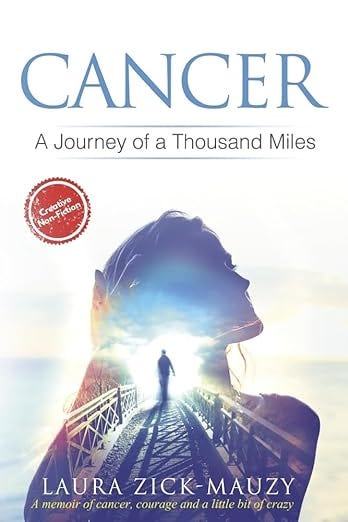
And therein was her reason for her book, which Laura wrote and designed on — her cell phone! She self-published it through BookBaby. It can be purchased directly from the author, BookBaby and Amazon. She’s also looking into doing an audiobook version because there is an audience of “readers” like her husband who just don’t like to read but enjoy a good story.
“I don’t like to read,” Paul admitted. “I’ll listen to the book. I’ll listen to it in the car or on the phone.”